
Top languages
The card reads the languages of the repositories you own or contribute to and ranks them. By default it weighs them by size — the bytes GitHub attributes to each language — which is what the progress bars show.
?username=octocat&langs_count=6When you have more languages than langs_count, the rest are drawn as one last row, Other,
so each share is a share of all your code rather than of the languages shown.
Required
Section titled “Required”| Option | What it is |
|---|---|
username | The GitHub login to read languages for |
Layouts
Section titled “Layouts”layout changes the shape entirely, and is the option worth trying first.
compact
Section titled “compact”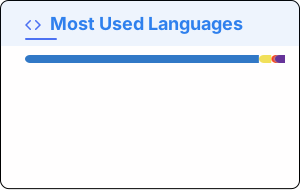
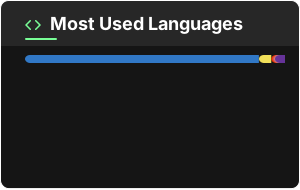
?username=octocat&layout=compact&langs_count=8One bar across the top, then the languages in two columns. It fits more languages in less height, which is what makes it the usual pick for a README sidebar.
?username=octocat&layout=donut&langs_count=6donut-vertical stacks the legend under the ring instead of beside it,
and pie fills the ring in.
Weighting
Section titled “Weighting”Two languages can rank differently depending on what you mean by “most”.
size_weight and count_weight set that:
| Weights | What it ranks by |
|---|---|
size_weight=1&count_weight=0 | Bytes of code — the default |
size_weight=0&count_weight=1 | How many repositories use the language |
size_weight=1&count_weight=1 | Both, multiplied together |
Jupyter notebooks
Section titled “Jupyter notebooks”GitHub counts a whole .ipynb file as Jupyter Notebook, saved outputs included, so one notebook
full of plots can outweigh the language it is written in. Hiding Jupyter Notebook drops those bytes
without giving the code back to Python.
?username=octocat¬ebooks=codenotebooks=code reads the notebooks of each repository GitHub says has some, and counts their
code cells as the kernel’s language: Python, R, Julia and so on. Markdown cells and outputs count
for nothing. A cell starting with a %% magic such as %%bash counts as that language. One whose
body is text, such as %%latex or %%writefile, counts for nothing, as does one in a language
GitHub’s bar leaves out, such as %%sql. A kernel the card does not recognize stays Jupyter
Notebook, without its outputs.
The default, notebooks=github, keeps GitHub’s count, because code costs requests on top of the
card’s usual one: one per repository to list its notebooks, for at most 10 repositories, and one per
notebook, for at most 25 notebooks. A repository it cannot read in full keeps GitHub’s count: one
with more notebooks than are left to read, a notebook over 2 MB or one it cannot download, or a
notebook GitHub leaves out of its count, such as one under docs/ or marked vendored.
Options
Section titled “Options”| Option | Values | What it does |
|---|---|---|
layout | normal compact donut donut-vertical pie | The shape of the card |
langs_count | a number | How many languages to name before Other |
hide_langs | language names | Languages to leave out |
exclude_repo | owner/name or name | Repositories to leave out |
size_weight | a number | Weight given to a language’s size |
count_weight | a number | Weight given to its repository count |
value_format | percent bytes | What the value beside each language reads |
hide_progress | true false | Drop the bars and keep the names |
hide_values | true false | Drop the numbers |
prog_bar_bg_color | a hex color | The unfilled part of each bar |
affiliation | OWNER COLLABORATOR ORGANIZATION_MEMBER | Which repositories count |
notebooks | github code | How notebooks count |
Plus the common options.